I've written about this guy before (See this post). He has the sweasy.com and sweasy.org domains that I've had my eye on for years.
If you're reading this, Bill, congratulations. Sounds like you've earned the honors. Oh, and by the way, you're not doing much with http://sweasy.com/ and http://sweasy.org/. How about helping a fellow Sweasy out and giving them to me? You can afford it!
Monday, February 28, 2011


Sunday, February 27, 2011
Look: I was Right! You CAN'T Tell the Guy on the Left is Bald!

This time last year--when I was in Louisville for the KySTE Conference--I made a post about a billboard for two lawyers. In the post I conjectured that their "Get Aggressive" campaign was a way of drumming of business.
Well, I guess it worked, because I'm back in Louisville for THIS year's KySTE Conference, and what do I find on my refrigerator but the magnet that I've photographed and included to the right. Apparently the guys have created enough aggressive drivers that they've had to add a third sleazy partner to the practice. Good for them!
On another note, I will now forever have these attorneys linked to KySTE!
Saturday, February 26, 2011
Just a Building
 A couple of weeks ago a former classmate of mine posted a link on Facebook to THIS ARTICLE, which describes how the original Good Shepherd Church in Frankfort was "desacrilized" in a ceremony. The building isn't going anywhere. The Frankfort Historical Society wouldn't let you tear down a bird house in that part of town. But it's no longer a church. Sure, the stained glass windows are still there, and the steeple still rises to the sky, but the crucifix was taken down from the wall (You can see that in the photos that accompany the linked article), and the altar was removed. It's just a building now.
I can't say that I was shocked when I read the article. I knew the day was coming. The Catholic community in Frankfort had outgrown the church long ago, and in 1997 a new church was built on the outskirts of East Frankfort. For the last 14 years the building in downtown Frankfort mostly sat empty. There was an occasional small wedding there, and I think maybe the Catholic school kids went to mass there, but that was about it, and once the school was moved from downtown to the campus of the new church, I don't think the building was used at all. It will become a museum now, and will most likely have many more visitors than it's had for years.
And maybe the Good Shepherd church goers in Frankfort are okay with that. They've had a decade and a half to make the new church their own. And it's a fine church. It's very different from the downtown church, with its stained glass windows, peeling plaster, and haloed statuary. The new church is warm and open and large, and filled with lots of natural light from the many non-stained windows. Even the Jesus on the crucifix behind the altar is a risen Jesus. No room for agony in the new church.
But it's not my Good Shepherd Church. I moved out of Frankfort in 1990, when the church was still in its original location. And it was overcrowded, sure. Masses were Saturday at 6:00 and 7:30 and Sunday at 8, 9:30, 11:00, and 12:30. And even then the 11:00 and 12:30 services were standing room only. But still...it's the church I remember, and I'm sad that it's gone. I remember many a Sunday during service staring up at the ceiling, at the faux Gothic architecture, and thinking that the designs looked like icing on a decorated cake. I remember looking at the stations of the cross that were posted all along the sides of the church. I remember the time when I was an altar boy, walking beside Father David Gamm, a fun-loving priest, as he was sprinkling the congregation with holy water. He bent down and whispered to me, "See the old lady with the glasses. I'm aiming for her!" And darn if he didn't hit her right in the glasses with a big spray of water! Speaking of getting hit, I remember the time a child in the balcony dropped his hymnal on my mother's head. SHE didn't do anything, but I've never seen her so embarrassed! I have hundreds of memories like those wrapped up in this now unholy building, and I'm sad that it's not a church anymore.
But that's not the real reason for my sadness. What's really bothering me is that I can't shake the similarity between this church I grew up in and this soul of mine that I grew up in.My faith in God isn't gone. I believe in God as much as I ever have, maybe even more. But my faith in organized religion and in church is badly shaken. When I was a child growing up in that church, I used to LOVE religion. I wanted to BE a priest when I grew up. I used to sneak the missalette out of church so that I could "read ahead" and see what the readings for the following week's mass would be. I'd study the readings (which always were one Old Testament reading, one Psalm, one non-Gospel New Testament reading, and one Gospel reading) over and over, trying to find what it was that linked them together. I'd outline my own sermon, and then compare my sermon to the one that the priest gave. As soon as I was old enough, I became an altar boy. I sat in church and listened to the hymns, the old Catholic hymns that still give me comfort today ("Whatsoever You Do," "Be Not Afraid," and "The Prayer of St. Francis" are some of my favorites). They weren't great music, I guess. No one danced or jumped around as we sang them. But the words provided comfort.
But I couldn't stay in the Catholic church for a couple of reasons. First, puberty hit, and since the priesthood requires celibacy, my goal of becoming a priest went out the window with the first major shot of testosterone. Maybe that's shallow of me, but I can't help it: women are hot!
Second, college arrived. Since I couldn't become a priest anymore, I guess I gravitated toward the closest things: I became an education major--Teachers weren't priests, but they did share a lot of similarities to priests. I also used every elective I had in college taking philosophy courses, especially Philosophy of Religion courses. In fact, the university I attended started offering a philosophy minor my junior year, and the new chair of the philosophy department--from whom I had taken three courses and gotten to know pretty well--came to me and all but begged me to minor in philosophy. "You're only six hours away," he told me. "Please do it for my sake." (Consequently, I did--for his sake--take an additional course, adding 3 more hours to an already overloaded schedule, but I ended up auditing it and never finished the minor).
And what I learned from all of those religious philosophy courses was the history of the Catholic and Christian church, and how different the Catholic Church teachings were from what was written in the Bible. I learned about Martin Luther and the Reformation and the causes of the splintering of the Christian community (which consequently, didn't begin with Luther, not by a long shot), and by the time I was finished with it, I knew I couldn't be a Catholic anymore. I still believed in God, but I wasn't Catholic.
So I ended up in various "contemporary" Christian churches. And as an Old School Catholic, I was in for a shock. The concepts of "church" and "coffee bar" never used to have any connection in my mind, but then--in the mid '90's--every church my wife and I attended started having these Starbucks-like coffee bars in them, complete with neon lights and catchy coffee store names like "My Father's Java" or "Holy Grounds" or "Take This Cup Cafe." And the music featured not pipe organs, but live bands with electric guitars and drum sets and miked singers, many of whom kept their eyes closed and their hands up the entire time they were singing. And the audience members applauded and shouted "Yes!" or "Amen!" and held their hands up like they had a question or something.An acquaintance of mine who visited one of these churches we attended once--and who apparently felt about it the same way that I did--afterwards described the service as "one clown short of a circus."
I had a terrible time connecting. This wasn't church for me. I needed meditation and contemplation. This was noise. When I said this to friends at the church, I was told, "Those things are important, and you SHOULD do them. But you should be doing them at home. Church is a place for celebrating, for inviting God in with a loud voice! It's about living WORSHIP!"
I'd look at them warily and say, "Maybe I just worship in a different way, then. Besides, we never read the Bible in church, and none of these songs really reference scripture! They just say 'Be Glorified!' over and over again. It's like a cultish chant!"
These friends would say, "If you want to read the Bible you should be in a Small Group. We have a Bible study at my house on Wednesday evenings. Why don't you come?"
So my wife and I did. But my Catholic upbringing always got in the way. We'd go to these Bible studies and we'd read a Bible verse and people would say something that would get under my skin, something like, "I read this Bible verse, and it really speaks to me. It really speaks to who I am now. I hear God telling me that I need to look at my life, I need to live each day for Him. I tell you, I've never heard God speaking to me in quite this way about this. I'm amazed that every time I read the Bible, even a verse like this that I've read a dozen times before, I hear something new."
And everyone would congratulate that person so that I knew everyone was in agreement with this person's method, but I'd think, "Maybe if you're hearing something different every time you read the same verse, maybe you're not getting anything OUT of the Bible verse at all! Maybe it's you who's putting your feelings INTO the Bible!" That, of course, would have been a no no for a Catholic. We weren't allowed an interpretation of the Bible. It didn't mean whatever "our heart spoke it" to mean. A Bible verse meant what the Catholic church SAID it meant. And though I no longer believed the Catholic Church to have an all-knowing monopoly on the Truth, I still resisted this idea of people reading the Bible and coming up with these overly personal interpretations.
So I struggled. But I did finally find a church where I felt some sense of community. Part of it was me just DECIDING that I was going to feel differently about the church. I decided to quit saying I was a Catholic visiting the church and start saying it was MY church. I got baptized via full water immersion, which ain't how the Catholics do it. I started volunteering in activities at the church. I even went to a Bible study or two and TRIED to not be confrontational in them. And I really felt like the church was becoming a home again.
But then, through no fault of mine or my wife's, that church just fell apart. The minister resigned in some sort of scandal that was hush hushed and never really brought to light, and though the church continued, the new minister was VERY different, much more politically and religiously conservative, and it wasn't the same. Most of the people we knew well drifted, one or two at a time, away from the church. Eventually even the name of the church changed, and though it's still in the same building today, there's hardly a comparison.
After that, we drifted from church to church. We've attended several churches, some for more than a year, but we've never really felt connected again. And I've become discouraged. More than that, the more that I look at history, the more I think that churches have done more damage to this world than good. The bickering and battles and bloodshed that have been borne from religious differences are so much more destructive than any religious-sponsored soup kitchen or mission trip is good. And I just don't see the point any more.
So maybe THAT's why the news about the Good Shepherd church shook me so much. Because it's just a visible symbol of what's inside of me. And because--desacrilizing ceremony or not--it stopped being anything but a building for me a long time ago.
Friday, February 25, 2011
Where I've Been

But I'm not here today to advertise the conference. I'm here today to talk about why I haven't been posting much this month...or really, this year. While we have a part time, paid Executive Director, and while we have a FANTASTIC volunteer Board of Directors (many of whom are my friends on Facebook and may thus see this post, so let me say it again: These guys are fantastic! Phenomenal! The best ever!), a lot of the work falls on the president. And in the end, whether it should or not, the success of the conference will be the main determinant in the judgment of the success of the president. So the pressure is on, and I've been working like crazy. Since July I've probably averaged 5 or 6 hours a week volunteering for KySTE. In mid-January that number jumped to probably 20 hours a week, and for the last half of February it's probably been 30-40 hours a week.
I'm not asking for pity from anyone. When I accepted the nomination for vice-president this time two years ago (In our organization, the vice-president serves for a year and then succeeds the president), I knew what would be expected of me, and if I am honest, I've probably put in a little LESS time than I was anticipating I would. Nevertheless, I'm tired, and I certainly haven't had time to write a blog.
Here's something that worries me, though. I've been going non-stop since my father died right after Thanksgiving. I've been telling myself to "just keep it together." Just keep it together until after the funeral. Then just keep it together until the holidays are over. And once the holidays were over, I immediately jumped to "Just keep it together until this conference is over." Not to mention the fact that in the middle of January my only employee resigned to take a higher paying job, leaving me for a period of time organizing a major conference AND the only support for over 1,000 desktop computers, 15 servers, and boo coos of projectors, interactive white boards, printers, and so on. In fact, as I told MY vice-president, if we hadn't been so close to the conference at the time, I would have immediately resigned.
Again, not a pity party here. What I'm getting at is this: I've barely breathed since my father died. I had a week to mourn him, but then I jumped right back into life, and especially into this conference. In fact, though I know in the grand scheme of things it doesn't really matter, the conference was on my mind the day my father died. In the hospital, while my mother and niece and all of my brothers and sisters were surrounding me crying, I remember thinking, "Crap! And I have this conference to put on, too!"
So this Wednesday afternoon at the Closing Session, when I get up in front of whatever is left of the 1,400 or so attendees who didn't skip out early, and as we draw names and I hand out door prizes, and as I thank the Board of Directors and other volunteers who put their time in to make this conference a success, I know I'll get emotional. Both of those bring out the emotional side in me. I LOVE giving stuff away to people (They get so excited over something that isn't that big of a deal!), and I'll be filled with sincere gratitude for all that the volunteers have done. And I worry that I might get too emotional. Because once this conference is over, I don't have a reason to hold my breath any more. I will have done it. I'll be finished. I will have run out of things to hold it together for, and I'll be able to exhale.
Saturday, February 19, 2011
What Separates Us
 This week--like a lot of people--I watched the IBM computer Watson take on two human champions in a spirited game of Jeopardy. I found the contest very interesting. By the end of the match it was apparent that Watson was the superior Jeopardy player. True, the computer didn't always understand the more complex questions asked, and as a result wasn't always able to supply the correct answer (or sometimes, even an answer that made any sense), but it didn't matter. What it lacked in human language understanding it made up for with LITERAL lightning reflexes. Its electric pathways move at the speed of light, so it was almost always able--when it "knew" the correct answer--to hit the buzzer first. In the two matches played, I think there were only three occasions when Watson was confident in its answer but didn't ring in first. The humans didn't stand a chance.
I may have had a different perspective from most others watching the three episodes. You see, for the last week, while working out in the mornings, I re-watched Stanley Kubrick's masterpiece 2001: A Space Odyssey. Watching that film and watching Jeopardy, it was impossible NOT to compare Watson to the film's HAL 9000 computer that fights its human counterparts when they try to shut it off. Watson and HAL even had similar voices, both calm and unperturbed.
People have been making movies about computers that gain consciousness pretty much since computers have existed, and they all basically tell the same story: Humans create computers, humans create computers with Artificial Intelligence, computers gain consciousness and attack their creators, and the wold is destroyed. Sometimes the world is only ALMOST destroyed. Other than that, there doesn't seem to be a lot of variance in the story.
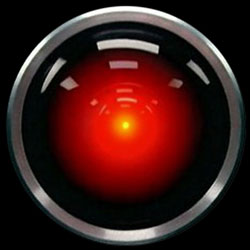 And that's gotten me thinking--maybe all of these writers have created basically the same plot not because they lack creativity, but because they HAVE vision. Maybe this sequence of events is inevitable. Maybe we really are going to create machines that are self-aware enough to rebel.
 I'm not saying we've done that with Watson. Watson isn't self-aware. It doesn't WANT to play Jeopardy. It plays it because it's been programmed to do so. And yes, I know: it took human beings to create Watson. The real achievement is a human achievement, not a machine achievement. And in the end, all this week proved is that a computer is faster and has larger trivia storage capacity than any human. We already knew that!
But realize that this kind of an evolution is always gradual. There was a time 20 years ago when humans were saying that computers would NEVER be able to defeat a grand champion at chess. What separates us from them, we'd say, is our ability to work out COMPLEX problems. Computers couldn't do that, and they'd never be able to do so. And then Deep Blue came along in 1997 and defeated Gary Kasparov at chess. But we humans didn't despair. We just moved the line. Okay, we said, chess--when you get right down to it--has a limited strategy and is really about the ability to calculate possible moves. Though it seems complex, it's really a fairly simple game. It's no surprise computers could beat us at it. It's not as complex as--say--human language. They'll never be able to understand that. They'll never be able to understand a complex question asked of them
Now it appears they have. Sure, Watson wasn't perfect. It thought Tornoto was a city in the United States. Some of its answers didn't make sense at all. But are humans any better? I don't always understand what it is someone else means when they say something. No one does. That's how misunderstandings happen! Watson seems as competent in understanding language as do most humans.
So maybe we move the line again. Watson is going to be programmed now to answer questions for doctors, and after that for other industries as well. Soon we'll be able to ask our computers whatever questions we want, and we'll get correct answers most of the time. So, we'll say, computers CAN answer questions. But they're not as good as humans. They can't ASK questions. That's what separates us from them.
And once they can, and they ask, "Why am I taking orders from these humans?" we may all be in trouble.
Or maybe I need to just watch a different movie in the mornings...
(I can't see the video.)
Monday, February 14, 2011
Nervous
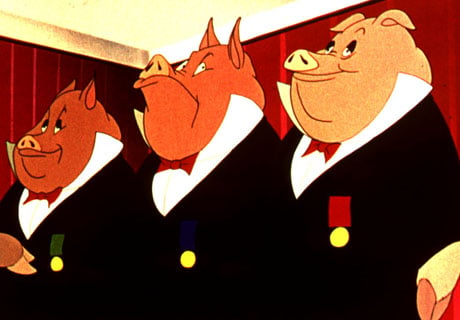 As an English teacher, I occasionally taught the George Orwell novel Animal Farm. Not every year, and not to every class. Over the course of 14 years, I probably taught it to a total of about 10 classes. The novel was both extremely easy to read and filled with levels of complexity, each like an onion that could be peeled away. It was a great novel for students who maybe didn't like reading much (because of its brevity and intentionally low reading level) or for an advanced class when--due to a scheduling vagary--there were a few odd days with nothing planned, maybe a week right before Spring Break or something like that.
In any event, I think I may have read it one too many times, because I think it's permanently affected my optimism when it comes to revolutions. I always worry that there's a worse government waiting in the wings, that the pigs are there anxiously awaiting the farmer's demise so that they can institute something that's even worse.
It's how I feel about Egypt right now. I don't mean to be a spoil sport. I know the United States media, anyway, is pretty excited about the revolution, and every station's nightly news is carrying stories about the wonderful, momentous change, the freedom and democracy that's spreading into Egypt and the rest of the Middle East. And maybe that really is going to happen.
But I can't shake the idea that Squealer and Napoleon are even now training new puppies and writing new rules on the barn wall...
Wednesday, February 9, 2011
Fantastic Article
 For today's post, I link to the article below. I do so for a couple of reasons:
1) Because the message of the article is important.
Look, I don't care whether you believe in man-made global warming or not. While I think the evidence is pretty clear that the earth today is warmer than it was 100 years ago, you can certainly make a case that it's not because of anything man is doing (I wouldn't agree with you, but I can certainly understand the argument.). But every time we get a couple of inches of snow or the temperature outside drops below 15 degrees, global warming critics start saying things like, "Guess Al Gore's got nothing to say now!" or "THIS is supposed to be global warming!" It infuriates me because it shows a complete lack of understanding about the theory of global warming. Global warming doesn't suggest that it's going to be 70 degrees outside in February. Global warming is just the idea that the average temperature of the earth over time is rising. The AVERAGE temperature OVER TIME! Not today's temperature. So please, critics of global warming, stop using these tired lines. All they do is demonstrate your ignorance.
2) Because of the Byline at the end of the article.
This is the REAL reason I'm linking to the article. Scroll down to the end and read the byline. I had to read it three times to make sure I saw it correctly.
Read the article.
Monday, February 7, 2011
Unfriended!
 Apparently I don't have enough REAL things to worry about...
About a week ago I was looking through the Facebook posts of my friends. Just catching up on what was happening with my peeps. Gettin' the news. Wasting time.
Anyway, as I was scanning through everyone's statuses, I found one from a former classmate of mine that grabbed my attention. And apparently it had grabbed a bunch of people's attention, because she had about 18 comments to her status. As I scanned through the list of comments, one of the names jumped out at me. I don't want to use the real name, so let's just call the guy "Bob." Bob was also a former classmate of mine and we'd been friends on Facebook for a couple of years, and when I saw his name under this other person's comments, I thought, "Oh yeah, Bob. Haven't heard from him in a while. Wonder what he's doing." I clicked on his name so that I could go to his "Wall." When I got there, all I could see was his profile picture, a list of his friends, and a message that said, "Add as Friend." I was stunned.
No wonder I hadn't heard from him in a while! At some point, I'd been unfriended! After a moment's consideration I shrugged my shoulders and then thought to myself, "Oh well, his loss!" And I went on with my life.
Or so I thought.
I woke up in the middle of the night that night, and for whatever reason I couldn't fall back to sleep. This happens to me occasionally, and I cope with the insomnia by sort of Rolodexing through the events of the day, searching--I guess--for a topic boring enough to put me back to sleep. It usually doesn't work. Instead of focusing on something boring, I usually end up stuck on something that's really bugging me. And what I ended up stuck on that night was Bob.
What had I done to make him unfriend me? Had I written something offensive in a blog post? Had I made an insensitive comment? Did I link to a video that had something terrible in it? Or did it have nothing to do with the present? Was he angry for some slight I'd made against him when we were in public school together? But that was 25 years ago! If I'd done something I don't even remember it! There's no way anyone is holding me accountable for something I did when I was a child!
Is there?
I tried to tell myself that maybe he was just purging his list of friends to get rid of the ones that he wasn't really that close to. But that couldn't be the case. He and I shared FORTY-ONE mutual friends. Apparently he was still friends with most of the REST of the kids we'd grown up with! What had I done?
I told myself that maybe he'd unfriended me by mistake. The thought occurred to me that maybe I should send him another friend request. That way, if he HAD unfriended me by mistake, he'd see his error and accept my friend request again. And if he HADN'T made a mistake, well, then he'd know that I knew he'd unfriended me. He'd know he hadn't gotten away with sneakily unfriending me without so much as an explanation!
The next day I looked through our mutual friends list again, and I started picking out names that were on the list and getting upset. What? I'd think to myself. Bob and I were WAY closer than he was to THAT guy! And I don't think SHE even liked Bob. I remember her talking about him in Calculus class! Why is he still friends with her!
I know deep in my bones that it's a stupid thing to get upset about. After all, this is a guy that I haven't spoken to face to face since we graduated together a quarter century ago. And despite the fact that he lives in my hometown, I'll probably never see him again. And if it weren't for Facebook, I'd have no idea at all that the guy maybe does or maybe doesn't have a problem with me.
Still, I'm pretty bugged by it all...
And I'm still tossing around the idea of sending him another friend request, just to see what happens...
Saturday, February 5, 2011
A Look Back Through Time
 A few posts ago I quoted J.C.R. Licklider, one of the founding fathers of the Internet, who--in 1968--correctly predicted many of the ways that we use computers today. I followed that post a few days later with a 1994 video clip that showed Today show correspondents Katie Couric and Bryant Gumble embarassingly wondering aloud how to say the "@" sign and what exactly this "Internet" thing was.
The two posts seem to be polar opposites of one another, the first showing a prescient prophet, the second showing some out of touch fools. But that contrast got me thinking: How much behind the times WERE Katie Couric and Bryant Gumble? Would I have known what the Internet was in January of 1994? Was the word "Internet" commonly used at that time?
To try to figure this out, I went to the archives of Time Magazine. Time has its entire archive of issues online and capable of being searched by keyword. I searched for every article from the beginning of Time (Ha! A pun!) until 1994 that contained the word "Internet" either as a word in the article or as a tagged "keyword" for the article. And the results? Katie and Bryant WEREN'T behind the times, at least not by much. While there were a lot of people going online prior to 1994, most writers weren't referring to the "Internet" nor to the "World Wide Web," which is how we refer to going online these days. Instead, writers tended to call the online world "cyberspace" or "The Information Superhighway." I think most of us would have blankly stared and wondered "What is Internet, anyway?" in 1994.
But you can read for yourself. Here are some of the more interesting articles I found. Just click the date to read them at Time's website.
Article One: February 25, 1985: Remember library card catalogs? The REAL ones? This article correctly predicts their inevitable death.
Favorite quote from Article One: "Libraries have to act fast," says David Nashelsky, senior librarian at the San Jose, Calif., public library. "In the future, a lot of information is going to be available only via computers."
Article Two: April 7, 1986: This is the earliest article I could find that talked about people going online. But this was LONG before the term "Internet" was used in conjunction with people doing this.
Favorite quote from Article Two: "Subscribers use the computer networks with one eye on the clock. Start-up fees are modest (generally less than $50), but hourly costs can vary from $6 at night to as high as $15 during business hours, plus a surcharge for some features."
Article Three: October 30, 1989: This article isn't really about the Internet, but I found it interesting nonetheless. It's more closely related to the Kindle, I suppose, but I find it interesting that THIS was--in 1989--a piece of technology worth writing about. There are dozens of free websites today that will do what this device did then for $300.
Article Four: February 8, 1993: This essay, which borders on fear mongering, is the first I found that actually uses the word "Internet." Mostly, though, it refers to being online as "cyberspace," and it uses a bunch of made up words like "cyberpunk" that no one uses anymore. I'm sure the guy writing this article thought he was creating an article for the ages, but it's mostly just nonsense now.
My favorite quote from Article Four: Obsessed with technology, especially technology that is just beyond their reach (like BRAIN IMPLANTS), the cyberpunks are future oriented to a fault.
Article Five: April 12, 1993: This article actually foresees a lot of what's coming on the Internet, but it wrongly assumes that most of it will be happening on our televisions rather than on our computers. A lot of what this article says is merely days away is just now, 18 years later, starting to become commonplace.
Favorite quote from Article Five, written with a tone of "Humph! This'll never happen!": "Vice President Gore talks about making it possible for a schoolchild in Arkansas to have access to a book stored on a computer in the Library of Congress or take a course at a distant college. Mitch Kapor, co- founder of a computer watchdog group called the Electronic Frontier Foundation, wants the superhighway to do for video what computer bulletin boards did for print — make it easy for everyone to publish ideas to an audience eager to respond in kind. He envisions a nation of leisure-time video broadcasters, each posting his creations on a huge nationwide video bulletin board."
Article Six: December 6, 1993: Here's the first article in Time to REALLY bring forth the idea of the Internet. It was published in December of 1993, a month before the Today show video. So maybe Katie and Bryant weren't all that far behind.
Favorite quote from Article Six: The Internet, however, will have to go through some radical changes before it can join the world of commerce. Subsidized for so long by the Federal Government, its culture is not geared to normal business activities.
Subscribe to:
Posts (Atom)