I was thinking just now about what I should write as my final blog post of the year, and then I couldn't come up with anything so I thought, "Why not just post a video that sort of sums up the year?" So I started looking through the top hits of 2011. LMFAO, Katy Perry, Adele. But then it hit me: The song below, though it's a quarter century old, sums up the past year like no other. Even my last post was about rebelling (though I didn't intend to draw any parallel--just dumb luck).
When I first heard this song I thought, We'll never see a day like what's being described in the song. But from Egypt to Wall Street to just about everywhere on the Internet, this song would fit right in. Tracy Chapman was just a little bit ahead of her time.
It'll be interesting to see if this spirit carries forward into the new year, and if it does what it means (good or bad) for the world...
(I can't see the video.)
Saturday, December 31, 2011


Wednesday, December 28, 2011
The Rebel Inside, part two
(Click here for part one.)
 I attended undergraduate school at Kentucky State University in Frankfort, my hometown. As is the case in most post-secondary schools, there was an orientation meeting scheduled for all incoming freshmen during the summer. I received a letter in the mail informing me of the day of my orientation, and listing an agenda for the morning. In addition, I was informed that all incoming freshmen at KSU were required to take the Comprehensive Test of Basic Skills (CTBS), a high school achievement test that I'd taken in May for the last four years in a row. The letter stated that I could take the three hour test in the afternoon on the same day as orientation, or I could take it on one of several other dates listed in the letter.
I wasn't looking forward to taking the CTBS test for a fifth time. When I'd taken it just a couple of months before I'd had a pretty keen sense of deja vu. Unlike the ACT or the SAT, the CTBS didn't change from year to year, so when I re-read the questions for the fourth year in a row, I hadn't even needed to read entire passages. I'd just skim the first sentence in the reading test, and think, "Oh yeah. THAT one!" and I'd then answer the question. Further, I'd just gotten my scores in the mail about a week before, and I'd gotten 12.9 (the highest possible score) in every section.
Why was I taking a high school test to get into college? I thought to myself. Weren't my ACT scores good enough? Wasn't my high school diploma good enough? Why go through this again? So I did what I felt was sensible: I took my printed test scores with me to the orientation. After lunch, when everyone was coming in to get ready to take the CTBS, I walked up to the man in charge (a white haired, bearded, rotund, older man who--if he didn't play Santa Claus at holiday gatherings--was missing a fantastic opportunity) and handed him my CTBS score sheet.
"Hi," I said. "My name is Bryan Sweasy, and I'm scheduled to take the test this afternoon, but I was wondering if--since I have my scores right here, and since they're perfect scores--that I might be excused from the test this afternoon." It seemed like a perfectly reasonable request to me, and I was sure that he would say yes. But no, I was informed that the scores I got in high school didn't matter, that the university wanted to know what my abilities were now. When I told him that I'd just taken the test six weeks ago and how could my abilities have changed much since then, he told me that for all he knew I'd forged the document in my hand and that for that reason he couldn't accept it. I'd have to take the test again.
I wasn't happy about it, but I sat down and took the test again. This was my first day on campus as an officially accepted student, and besides, I had a university scholarship on the line. I didn't want to make any waves. I wasn't happy about it, though, and when I got my scores in the mail in a few days and they were again 12.9 across the board, I really felt like I'd wasted my time.
But that was just the beginning of this story. I forgot all about the CTBS test until two April's later, at the end of my sophomore year, when I received another letter from the university stating that all students finishing their second semester of their sophomore year were required to re-take the CTBS test in order to measure growth. The letter listed a series of dates for the test and stated which one I'd been assigned to. If I couldn't make that date I needed to select another. The letter ended by stating that sophomore students who did not complete the re-take of the CTBS would be denied credit for their second semester courses.
This must be some mistake, I thought to myself. What growth could I possibly have? There was no way that the university intended for ME to re-take the CTBS. I looked at the date on the letter and made note of it. I then called the university and made an appointment to see the professor whose name was on the letter. My appointment was the day before my test. I took BOTH copies of my CTBS scores (the ones from high school and the ones from my orientation), and I walked into the room on the day of my appointment, and there was Santa Claus behind a desk.
After a few moments of introducing ourselves, I held up my CTBS papers and said, "Look, I scored a 12.9 when I was a senior, and I scored a 12.9 at freshmen orientation. The letter says you're trying to measure growth, but there's no way to grow when I already have a perfect score. I don't see why I should have to take this test again. It's a waste of my time."
Santa stared at me for a moment before laughing and saying, "The point of having all students take and re-take the test isn't to measure an individual's growth. It's to see how we're doing as a university. With that in mind, there may be students, such as yourself possibly, who actually score LOWER on the re-test your sophomore year. So it's okay that you don't have room for growth. Besides, that may not actually be true. Just because you have a 12.9 doesn't mean you have a perfect score. The 12.9 just places you in a grade level, and that is as high as it measures. You can get a 12.9 without getting a perfect score. And the 12.9 isn't the number we use. It's the smaller, raw score number that we use."
I examined my tests. "Huh," I said. "I see the raw score number. And you know what? It's the same for every subject on both the one I took in high school and the one I took at orientation. How close are these to a perfect score?" I handed him the two score sheets.
He took them with a smile and stared at them for a moment, and then, with a smile still on his face, he pulled out another sheet of paper he had in a folder and compared my scores to that paper. After a moment his smile vanished, and he glared at me for a second or two before leaning in to the two papers even a little more closely.
"How did I do?" I asked. "How close was I to a perfect score?"
"It doesn't matter!" he snapped as he all but threw my papers back at me. "It doesn't matter whether you have a perfect score or not. All sophomores are required to take the CTBS again!"
"Well, I'm not doing it!" I said vehemently.
"That's FIIIINNNNNE!" he said, a fake kindness in his voice. "You just won't receive any credits for this last semester."
Now I was the one to glare at him. A dozen comments popped into my mind, but (and I must say I'm proud of this) I withheld all of them. Then an idea popped into my head. To quote from Boris Karloff in the Grinch, I got "a horrible, awful idea" (At least, it was GOING to be a horrible idea for me!).
I smiled. "Okay, then. I guess I have to take the test. I really appreciate your time, and I can see that you're doing a bang up job here. Thanks again." His eyes narrowed, but he accepted my words at face value, and we parted ways. The next day I came, took the test, and thought the whole matter was over.
I'd pretty much completely forgotten about the entire incident, in fact, when in September of that year I got a letter in the mail from the Vice President of Academic Affairs stating that I had an appointment with her the following Monday at 10 o'clock. I'd met her once before, back in May. I was one of four sophomores to serve as Honor Guard for the senior graduation, and the four of us had met with her then. She seemed to take a liking to me, and I liked her, too. I didn't for the life of me, though, know what she would want. I called her office and her secretary answered. I informed her that I'd received the letter and that I had a class during the time of the appointment, and could we reschedule. The secretary put me on hold for a moment, and then came back and said, "She said to tell your professor that you're going to miss that class. You need to see her."
So I did. And at 10 o'clock on Monday I walked into the Vice-President's office still without any idea that anything was wrong. When I walked in and saw Santa Claus sitting in one of the two visitor's chairs, though, I froze.
"Hello, Bryan," she said to me. "Come on in and take a seat." I did so. Slowly. As I eased into the leather chair, I glanced over at Santa, who was glaring at me.
After a moment's silence, she said, "I suppose you know why you're here."
I knew EXACTLY why I was there. "I honestly have no idea," I said as innocently as possible.
She turned her head and looked at me out of the corner of her eye. "Bryan," she began, "every student in this university is required to take the CTBS at the end of his or her sophomore year."
"I know," I said. "And I took it. I didn't want to, but I took it."
"You did?" she said, in a way that suggested she wasn't buying anything I was saying.
"That's right," I said. "I took the test just like I was asked."
"Then we have a problem. Professor, would you like to explain?"
I turned to Santa. He was smiling again, and he began talking again that fake, kind way. "Bryan," he began, as if were lecturing me in a class, "I teach Statistics. I'm a statistician. And let me explain something to you. The Comprehensive Test of Basic Skills is a multiple choice test with four possible answers per choice. If someone knew NOTHING about the content on the test, one would expect him or her to score somewhere around a 25%. I could hand someone a score sheet and--even without seeing the questions--that person could guess and get somewhere around a 25%. Would you agree?"
"I don't know," I said sheepishly.
His kindness disappeared. "Of course you agree! You're a bright fellow! After all, you've scored a perfect score at least twice on the test! Right?"
I smiled triumphantly. "I KNEW my raw score was a perfect score! I KNEW it!"
"That's not important now," Santa Claus said. "What matters is this: The chances that someone could take the test, put in his best effort, and somehow miss EVERY question on the test, is almost impossible. Those odds become even larger when the person has a previous perfect score. That's why," he finished, "the only thing that I can assume is that you missed every question ON PURPOSE!"
There was a moment of silence while he glared at me. I was sure I was about to get kicked out of the university, or at least put on probation or something. And then I heard a strange noise from the direction of the Vice-President. I glanced over at her, and found that she was stifling a laugh. I grinned, too, and my grin sent her into an outright laugh.
Santa Claus did not join us. "This is SERIOUS!" he said loudly. "Because of this, the entire results are skewed!"
I didn't even listen to him. I turned to the Vice President and said, earnestly, "I'm sorry, Dr. Smith. I shouldn't have done it. I just didn't want to take the test. What do I have to do to make this right?"
"I need a letter of apology from you to [Santa Claus--sorry, I forget the guy's name] explaining what you've learned." I nodded that I was okay with that. "I also need a letter from you to me explaining why I shouldn't put you on probation and how you're going to avoid situations like this in the future." Again I nodded. "And," she said, "you're going to need to retake the CTBS one more time, at [Santa Claus'] convenience, and this time take it seriously."
"I have to do all that AND take the test AGAIN?" I was exasperated.
She nodded gravely. "Yes, you do. And you should count yourself lucky that this isn't going on a permanent record anywhere. If it were just about anyone else, I think it would be."
So I took the test again. And I tried my best. And in the end, to the great celebration--I think--of Santa, I actually missed one of the mathematics questions. I'm sure he felt vindicated.
Not me. I felt beaten. Don't get me wrong. I was grateful for what Dr. Smith had done for me. But I also realized a painful lesson: The consequences of rebellion can be pretty significant. If I was going to be a rebel, that was fine, but I needed to choose my battles. And I needed to consider in advance what the consequences would be for my rebellion, and I needed to be willing to live with them.
So I'm a lot more compliant today than I used to be. I grew up a lot that day in the office of the Vice President for Academic Affairs. And today, I'll let people know if I think what I'm being asked to do is a bad idea, but when push comes to shove, I'll probably hunker down and do the work. But that rebel is still inside me, so I'll repeat to you what I say over and over again to my wife:
Don't tell me what to do.
I wasn't looking forward to taking the CTBS test for a fifth time. When I'd taken it just a couple of months before I'd had a pretty keen sense of deja vu. Unlike the ACT or the SAT, the CTBS didn't change from year to year, so when I re-read the questions for the fourth year in a row, I hadn't even needed to read entire passages. I'd just skim the first sentence in the reading test, and think, "Oh yeah. THAT one!" and I'd then answer the question. Further, I'd just gotten my scores in the mail about a week before, and I'd gotten 12.9 (the highest possible score) in every section.
Why was I taking a high school test to get into college? I thought to myself. Weren't my ACT scores good enough? Wasn't my high school diploma good enough? Why go through this again? So I did what I felt was sensible: I took my printed test scores with me to the orientation. After lunch, when everyone was coming in to get ready to take the CTBS, I walked up to the man in charge (a white haired, bearded, rotund, older man who--if he didn't play Santa Claus at holiday gatherings--was missing a fantastic opportunity) and handed him my CTBS score sheet.
"Hi," I said. "My name is Bryan Sweasy, and I'm scheduled to take the test this afternoon, but I was wondering if--since I have my scores right here, and since they're perfect scores--that I might be excused from the test this afternoon." It seemed like a perfectly reasonable request to me, and I was sure that he would say yes. But no, I was informed that the scores I got in high school didn't matter, that the university wanted to know what my abilities were now. When I told him that I'd just taken the test six weeks ago and how could my abilities have changed much since then, he told me that for all he knew I'd forged the document in my hand and that for that reason he couldn't accept it. I'd have to take the test again.
I wasn't happy about it, but I sat down and took the test again. This was my first day on campus as an officially accepted student, and besides, I had a university scholarship on the line. I didn't want to make any waves. I wasn't happy about it, though, and when I got my scores in the mail in a few days and they were again 12.9 across the board, I really felt like I'd wasted my time.
But that was just the beginning of this story. I forgot all about the CTBS test until two April's later, at the end of my sophomore year, when I received another letter from the university stating that all students finishing their second semester of their sophomore year were required to re-take the CTBS test in order to measure growth. The letter listed a series of dates for the test and stated which one I'd been assigned to. If I couldn't make that date I needed to select another. The letter ended by stating that sophomore students who did not complete the re-take of the CTBS would be denied credit for their second semester courses.
This must be some mistake, I thought to myself. What growth could I possibly have? There was no way that the university intended for ME to re-take the CTBS. I looked at the date on the letter and made note of it. I then called the university and made an appointment to see the professor whose name was on the letter. My appointment was the day before my test. I took BOTH copies of my CTBS scores (the ones from high school and the ones from my orientation), and I walked into the room on the day of my appointment, and there was Santa Claus behind a desk.
After a few moments of introducing ourselves, I held up my CTBS papers and said, "Look, I scored a 12.9 when I was a senior, and I scored a 12.9 at freshmen orientation. The letter says you're trying to measure growth, but there's no way to grow when I already have a perfect score. I don't see why I should have to take this test again. It's a waste of my time."
Santa stared at me for a moment before laughing and saying, "The point of having all students take and re-take the test isn't to measure an individual's growth. It's to see how we're doing as a university. With that in mind, there may be students, such as yourself possibly, who actually score LOWER on the re-test your sophomore year. So it's okay that you don't have room for growth. Besides, that may not actually be true. Just because you have a 12.9 doesn't mean you have a perfect score. The 12.9 just places you in a grade level, and that is as high as it measures. You can get a 12.9 without getting a perfect score. And the 12.9 isn't the number we use. It's the smaller, raw score number that we use."
I examined my tests. "Huh," I said. "I see the raw score number. And you know what? It's the same for every subject on both the one I took in high school and the one I took at orientation. How close are these to a perfect score?" I handed him the two score sheets.
He took them with a smile and stared at them for a moment, and then, with a smile still on his face, he pulled out another sheet of paper he had in a folder and compared my scores to that paper. After a moment his smile vanished, and he glared at me for a second or two before leaning in to the two papers even a little more closely.
"How did I do?" I asked. "How close was I to a perfect score?"
"It doesn't matter!" he snapped as he all but threw my papers back at me. "It doesn't matter whether you have a perfect score or not. All sophomores are required to take the CTBS again!"
"Well, I'm not doing it!" I said vehemently.
"That's FIIIINNNNNE!" he said, a fake kindness in his voice. "You just won't receive any credits for this last semester."
Now I was the one to glare at him. A dozen comments popped into my mind, but (and I must say I'm proud of this) I withheld all of them. Then an idea popped into my head. To quote from Boris Karloff in the Grinch, I got "a horrible, awful idea" (At least, it was GOING to be a horrible idea for me!).
I smiled. "Okay, then. I guess I have to take the test. I really appreciate your time, and I can see that you're doing a bang up job here. Thanks again." His eyes narrowed, but he accepted my words at face value, and we parted ways. The next day I came, took the test, and thought the whole matter was over.
I'd pretty much completely forgotten about the entire incident, in fact, when in September of that year I got a letter in the mail from the Vice President of Academic Affairs stating that I had an appointment with her the following Monday at 10 o'clock. I'd met her once before, back in May. I was one of four sophomores to serve as Honor Guard for the senior graduation, and the four of us had met with her then. She seemed to take a liking to me, and I liked her, too. I didn't for the life of me, though, know what she would want. I called her office and her secretary answered. I informed her that I'd received the letter and that I had a class during the time of the appointment, and could we reschedule. The secretary put me on hold for a moment, and then came back and said, "She said to tell your professor that you're going to miss that class. You need to see her."
So I did. And at 10 o'clock on Monday I walked into the Vice-President's office still without any idea that anything was wrong. When I walked in and saw Santa Claus sitting in one of the two visitor's chairs, though, I froze.
"Hello, Bryan," she said to me. "Come on in and take a seat." I did so. Slowly. As I eased into the leather chair, I glanced over at Santa, who was glaring at me.
After a moment's silence, she said, "I suppose you know why you're here."
I knew EXACTLY why I was there. "I honestly have no idea," I said as innocently as possible.
She turned her head and looked at me out of the corner of her eye. "Bryan," she began, "every student in this university is required to take the CTBS at the end of his or her sophomore year."
"I know," I said. "And I took it. I didn't want to, but I took it."
"You did?" she said, in a way that suggested she wasn't buying anything I was saying.
"That's right," I said. "I took the test just like I was asked."
"Then we have a problem. Professor, would you like to explain?"
I turned to Santa. He was smiling again, and he began talking again that fake, kind way. "Bryan," he began, as if were lecturing me in a class, "I teach Statistics. I'm a statistician. And let me explain something to you. The Comprehensive Test of Basic Skills is a multiple choice test with four possible answers per choice. If someone knew NOTHING about the content on the test, one would expect him or her to score somewhere around a 25%. I could hand someone a score sheet and--even without seeing the questions--that person could guess and get somewhere around a 25%. Would you agree?"
"I don't know," I said sheepishly.
His kindness disappeared. "Of course you agree! You're a bright fellow! After all, you've scored a perfect score at least twice on the test! Right?"
I smiled triumphantly. "I KNEW my raw score was a perfect score! I KNEW it!"
"That's not important now," Santa Claus said. "What matters is this: The chances that someone could take the test, put in his best effort, and somehow miss EVERY question on the test, is almost impossible. Those odds become even larger when the person has a previous perfect score. That's why," he finished, "the only thing that I can assume is that you missed every question ON PURPOSE!"
There was a moment of silence while he glared at me. I was sure I was about to get kicked out of the university, or at least put on probation or something. And then I heard a strange noise from the direction of the Vice-President. I glanced over at her, and found that she was stifling a laugh. I grinned, too, and my grin sent her into an outright laugh.
Santa Claus did not join us. "This is SERIOUS!" he said loudly. "Because of this, the entire results are skewed!"
I didn't even listen to him. I turned to the Vice President and said, earnestly, "I'm sorry, Dr. Smith. I shouldn't have done it. I just didn't want to take the test. What do I have to do to make this right?"
"I need a letter of apology from you to [Santa Claus--sorry, I forget the guy's name] explaining what you've learned." I nodded that I was okay with that. "I also need a letter from you to me explaining why I shouldn't put you on probation and how you're going to avoid situations like this in the future." Again I nodded. "And," she said, "you're going to need to retake the CTBS one more time, at [Santa Claus'] convenience, and this time take it seriously."
"I have to do all that AND take the test AGAIN?" I was exasperated.
She nodded gravely. "Yes, you do. And you should count yourself lucky that this isn't going on a permanent record anywhere. If it were just about anyone else, I think it would be."
So I took the test again. And I tried my best. And in the end, to the great celebration--I think--of Santa, I actually missed one of the mathematics questions. I'm sure he felt vindicated.
Not me. I felt beaten. Don't get me wrong. I was grateful for what Dr. Smith had done for me. But I also realized a painful lesson: The consequences of rebellion can be pretty significant. If I was going to be a rebel, that was fine, but I needed to choose my battles. And I needed to consider in advance what the consequences would be for my rebellion, and I needed to be willing to live with them.
So I'm a lot more compliant today than I used to be. I grew up a lot that day in the office of the Vice President for Academic Affairs. And today, I'll let people know if I think what I'm being asked to do is a bad idea, but when push comes to shove, I'll probably hunker down and do the work. But that rebel is still inside me, so I'll repeat to you what I say over and over again to my wife:
Don't tell me what to do.
Friday, December 23, 2011
The Rebel Inside, part one

I snap at her, "Don't tell me what to do!"
I'm not sure why I do it, to be honest (and I've actually been consciously making an effort lately to not do it). It's a knee jerk reaction in me. I guess it's supposed to be a joke. But it's neither funny nor amusing anymore (if it ever was). Mostly it's just one more quirk that ensures that--if anything ever happens to Lisa--I'll be unable to ever sustain a serious relationship with another woman...
But I'm not here to talk about my marriage today. I'm here to talk about this: every joke (even a bad, annoying one) has an element of truth in it. And though I rarely ever really refuse any request my wife makes, my instant desire to reject any command put on me points to a basic personality characteristic (or maybe defect) that I possess.
I don't like to be told what to do.
I've wrestled my whole life with a tendency to want to reject anything that I've been told I HAVE to do. If I'm ordered to do something I always bristle a little, but it's even worse for me if what I am being asked to do sounds unreasonable. And I still struggle with this tendency today. There are about ten different posts on this blog (see here, here, and here for just a sample) that focus on the fact that any sign telling me not do to something just makes me want to do whatever it is I've been told not to do. And sometimes this tendency has gotten me in trouble...
I remember two specific incidents that occurred within a very short period of time when I was in the sixth grade. First, my entire grade was taken on a field trip to see THE NUTCRACKER ballet. As the teachers were preparing for the trip, they went through the list of rules we'd have to follow. Most were pretty standard rules that you'd expect on any field trip (No shouting on the bus, No wandering off alone, No "horseplay"), but one rule was unique to this trip.
"Finally," my teacher said severely, "I don't want to hear anyone laughing at the men in tights." As soon as she said this, most of the students in class started laughing uproariously. This seemed to make the teacher angry, and she furrowed her brows and shouted, "I MEAN it! No laughing during the performance if there are men in tights on the stage, or there's going to be big trouble!" Her anger just made the class laugh more.
I was NOT one of the students who laughed. I guess I should be embarrassed to admit this, but at age 12 I didn't know what tights were, and I also didn't know why anyone would laugh at a man wearing tights (Thirty years later, I have a pretty good idea of what the joke was). In any event, I thought it a little unfair that we should be punished for laughing, something that is a pretty automatic response and hard to suppress, so I decided that--whether I got the joke or not--I WAS going to laugh at the man in tights. Trevor, one of my friends in 6th grade, sat beside me at the performance, and he was one of the people who, that first day, had seemed really amused by the whole guy/tights thing, so I asked him to let me know when a guy in tights came out.
I was actually pretty sure it was never going to happen. The whole ballet seemed interminable to me. It was interesting at first to hear the thrilling sound that was the orchestra playing, and it was interesting at first to see the delicate women in the equally delicate and colorful costumes come out onto the stage and dance. I was especially entranced by their ability to stand on their toes and leap around. But then the same thing seemed to happen over and over again, and I pretty soon lost interest. I wasn't even watching the ballet, in fact, but was looking around the performance hall and noticing how each section, row, and chair were either numbered or lettered, when Trevor elbowed me in the side and whispered, "There's a guy in tights on stage, Bryan!"
I took in a deep breath and laughed as loudly as I could before shouting, "Hey! Look at the guy in tights! That's hilarious!"
I got in a lot of trouble for that one...
Later that school year, my rebellious side caused more trouble. I had been identified as being "Gifted and Talented," and as a result I'd been placed into my elementary school's Gifted and Talent program, which was called--for reason unknown to me then and now--"Pegasus." This blog post is already getting to be a little bit on the long side, so I'm not going to go into all of the reasons why I had trouble getting along with the Pegasus teacher (some reasons which--looking back as an educator--were quite valid on my part, and some that were just me being a jerk). That may be fodder for a later blog post. Suffice it to say, though, that I DID have trouble getting along with her. I KNOW I was a thorn in her side, and she certainly was in mine.
Our disagreement came to a head when she asked us to complete an activity that didn't seem like a good one to me. I whispered to a fellow Gifted and Talented classmate (probably Trevor again), "I don't want to do this. This is stupid..."
The teacher overheard me and I guess misunderstood what I'd said. She quickly walked over to me and got her face about a foot and a half from mine. "Bryan!" she sternly said. "If you have something to say about ME, I suggest you say it to my face!"
This was unlike her. She was a VERY soft spoken, kind, demure teacher (In retrospect, I wonder if she hadn't complained to some veteran teacher about her problems in class and the teacher had told her to "get tough" with me). In any event, I was taken aback. "I didn't say anything about YOU," I tried to explain. "I just..."
"Nope! Nope! Nope!" she all but shouted into my face. "If you have something to say about ME, you need to say it directly to me!"
The response that came into my head I KNEW was going to get me into trouble, but I felt trapped by the situation, and I honestly couldn't stop myself. "Okay," I said slowly and quietly to her as I stared unblinkingly into her eyes. "YOU'RE stupid!..."
That comment landed me in the principal's office for a conference with the principal, the Pegasus teacher, her supervisor from the Board of Education, and my mother. I don't recall the entire conversation (I've tried to block such unpleasant memories from my mind), but I do remember my mother finally saying, "It sounds like Bryan is just unhappy in the Pegasus class, and maybe he should just be pulled from it."
The board of education supervisor, who had been mostly just observing, stood up immediately and said, "I'm afraid you don't understand. Once a student is labeled Gifted and Talented they ARE Gifted and Talented, and we have to provide services. No one's ever left the Pegasus program before. I mean there's just--" She paused, trying to find the right words. "--No one's ever quit before. He can't!"
There were several more minutes of conversation, and I was kind of like a witness in a criminal trial. I was there, but no one was allowing me to testify. Finally, though, the elementary principal, Mr. Johnson, turned to me and said, "Bryan, what do you have to say for yourself?"
I pointed to the woman from the Board of Education. "Did you just say that I CAN'T quit Pegasus?"
"That's right," she said. "No one's ever quit before."
I turned to my mom and Mr. Johnson. "Okay, then. I DEFINITELY quit!"
And so I was pulled out of the Pegasus program for the remainder of the year. The following year I moved on to the middle school and had a different Gifted and Talented teacher and everything was fine again. But I missed a lot of opportunities in that Gifted and Talented class, including the chance to go to Washington, D.C. with my classmates. All because of my resistance to being told what to do.
Okay, and maybe because I was a little bit of a jerk, too...
Though--as I mentioned before--the tendency to be a rebel is with me still, I FINALLY learned that knee jerk rebellion wasn't worth the consequences in my second year of college. I came perilously close to getting kicked out of the university I was attending.
But this blog post is long enough already, so I will tell THAT story in a later post.
Monday, December 19, 2011
No Santa

As I watched the film I pondered the great lengths that people in our culture go to in order to perpetuate the Santa Claus story. They tell children, when they are young and impressionable, about this rotund man who rides from house to house delivering toys to children in a flying sled pulled by magical reindeer, and they convince them that this story is true. And then, when the children get a little bit older and begin to question the veracity of this story, they use stories like The Polar Express and The Santa Claus and Elf and Miracle on 34th Street to ridicule them for having the audacity to question the preposterous nature of the story.
No wonder, when they get older, children get resentful and don't trust their parents!
My wife and I never presented the Santa Claus story as real. Neither did we tell our children there was an Easter Bunny or a Tooth Fairy. We were both serious Christians, and we reasoned that what kind of integrity would we have in our children's eyes if we told them all of those stories were true? How could our children ever believe what we were saying about Jesus? Because Christian or Jew or Muslim or Atheist, I think everyone can agree on this: If the story of a man in a red suit delivering presents sounds ridiculous, and if the story of a pink lagomorph sneaking into a home with candy on Easter Day sounds ridiculous, and if the story of a supernatural creature exchanging your worthless teeth for human money sounds ridiculous, then the story of a young teenage girl getting impregnated by the one and only God and bearing a child who walked on water, healed the sick, single handedly multiplied fish and bread, was executed as payment for the sins of the world (including all of the sins that had as yet not occurred), and then--after being buried for three days--rose from the dead like a zombie and then swooshed off into heaven like Superman, sounds just as ridiculous. How could we say to our children, "No, THESE improbable sounding stories were all invented by our society as sort of a way of just messing with kids, but THIS improbable sounding story--it's true!"? We didn't think we could do that. So we didn't.
So our kids grew up without Santa Claus. Well, that's not exactly true. It's impossible to escape from Santa Claus at Christmas time, so we did have to explain what in the world that was all about. We told the children that the adults and children were all playing a game where they pretended that Santa Claus was real and brought the presents. It was the best explanation we could come up with. And our children never really bought it.
I remember talking with my older daughter about it when she was about four years old, and she already understood that our explanation wasn't quite right. "They're all playing a game?" she asked like an attorney leading me into a trap.
"Yes," I said. "It's just a way to get excited about Christmas."
"But the children think that Santa Claus is real?"
"Yes," I said. "That's what their parents tell them."
"But all of the parents know that he's NOT?"
"That's right."
Her eyes narrowed a little. "That doesn't seem like a game, then. That seems like a lie."
I didn't really have an answer for that, so I just kind of stared at her for a moment before slowly saying, "Yeahhhhhhh, but now, here's the thing: you can't tell anyone who believes in Santa that he's not real."
"Why not?"
I smiled. "Well, a couple of reasons. One, they're not going to believe you--they're only going to get mad at you. And the parents are going to be mad, too, because if you tell them it's not real, then the game is over."
"You mean the LIE is over."
I stared at her again. "You can't tell anyone."
And of course, they didn't believe me. They had to find out for themselves. I distinctly remember my younger daughter running into a relative's house one summer day holding her forehead and screaming in pain. When she finally calmed down I found out what she was screaming about: her younger cousin had beaned her in the head with a rock. As Lisa went and got some ice for the obvious welt that was growing on her head, I said, "Why would he do that?"
She said, "Because I told him that Santa Claus wasn't real!" Before I could say anything she said, "I know you told me not to, but I did. I'm sorry..."
I'm not telling this story to brag on what terrific, wonderful parents Lisa and I are. In fact, I'm not even sure that's true. Sometimes I even worry that it may be the exact opposite. I don't even know how big of a deal it is to "play" the Santa Claus "game." Lisa and I both believed in Santa Claus, and I don't think we're any worse for the wear. One night when my older daughter was a little bit older, maybe in upper elementary school, as I was tucking her into bed for the night she said to me, "Daddy?"
"Yes?"
"I know there's no such thing as Santa Claus, but sometimes I wish...I wish I had believed in him once..."
I thought about that as I went upstairs to say good night to the girls after watching The Polar Express the other night (No, I don't tuck them into bed anymore--I quit doing that a long time ago--but I still say goodnight to them most nights.). I went into my younger daughter's room and said, "Goodnight."
"Goodnight, Dad. Will you close the door?"
"Sure," I said as I started to close the door, and then I turned and said, "Hey..."
"Yeah?"
"Do you think you missed some essential childhood experience because you never believed in Santa Claus?"
"No!" she answered, as if I had asked her the most ridiculous question in the world.
"Do you think Christmas would have been more exciting if you had?"
"No!" she said. "Christmas is pretty awesome! It's the presents that matter. No one cares who brings them as long as you get them!"
"That's good to hear," I said as I closed her door. "Goodnight!"
I walked into my older daughter's room. "Goodnight," I said. "Hey, do you still wish you used to have believed in Santa Claus?"
"What?"
"When you were little you told me that you WISHED you'd believed in Santa Claus once. Do you still believe that?"
She shook her head. "I don't remember that. I think you're making it up. And no."
I repeated the question I'd asked my younger daughter. "You don't think you missed some essential childhood experience by not believing in Santa Claus?"
"No way!" she said. "I'm GLAD he's not real!"
"Really? Why?"

I laughed. "Never thought of it that way. When you say it that way, I kind of agree with you." I thought for a moment. "So you don't think Christmas is any less exciting because you don't believe in Santa Claus?"
Her eyes widened and she got serious. "What are you saying, Dad? Am I not getting my iPod Touch?"
I laughed. "No, that's not what I'm saying at all." I thought for a moment and then added, "I'm not saying you ARE, either." I looked up at her ceiling, trying to figure out what I WAS trying to say. "I guess I'm just wondering, would it have been nice for you to have heard that bell once, too?"
"Dad," she said.
"Yes?"
"You and Mom are good parents. Just go to bed."
So I did...
Sunday, December 18, 2011
I guess--technically--I'm breaking copyright, too!...
Lisa and I just watched Saturday Night Live from last night and thought it was one of the best shows of the season. I then went online to see what others were saying about it. I ended up on this web page, and found the comments at the bottom of the article to be a little over the top. Apparently people take this religion thing WAY too seriously. I thought the skit was very funny.
On the other hand, I guess if Mohammed had been the character in the skit that it would have caused a holy war.
I embedded a video of the skit below...
(I can't see the video.)
P.S. If you go to the actual YouTube page, I find it funny that the guy who posted this video writes "no copyright infringement intended," as if that excuses anything!...
On the other hand, I guess if Mohammed had been the character in the skit that it would have caused a holy war.
I embedded a video of the skit below...
(I can't see the video.)
P.S. If you go to the actual YouTube page, I find it funny that the guy who posted this video writes "no copyright infringement intended," as if that excuses anything!...
Wednesday, December 14, 2011
The bleeping microphone

Imagine that you're sitting at a meeting of some sort. A training or a workshop maybe. It's a large crowd, and the speaker is using a microphone and audio system to project his voice to the back of the room. After talking for several minutes and engaging the audience, the speaker then introduces another person. There is applause for the new person as he walks to the front of the room, and then the previous speaker hands the microphone to the new speaker.
This new speaker does one of two things. He either takes the microphone and looks at it for a few seconds like it's some strange object he's never seen before (think of the ape creature with the bone at the beginning of 2001: A SPACE ODYSSEY) and then hands the microphone right back to the first speaker, or the second speaker outright refuses to even touch the microphone. The people in the first few rows might hear the new speaker mumble something like, "I hate those things." Then the new speaker draws in a deep breath, stands up straight, and shouts--absolutely SHOUTS--as loudly as he can, "CAN EVERYBODY HEAR ME IN THE BACK?"
It's to that second speaker that I want to address this blog post today. And here's what I want to say:
Use the BLEEPing microphone, moron!
If you just used the microphone, you wouldn't have had to begin your speech with that question! You'd KNOW the people in the back could hear you. Also, you wouldn't have to shout so loudly that the people in the front have to recoil in pain. Also, you wouldn't strain your voice. Also, you wouldn't have to do what you inevitably end up doing, which is take the microphone anyway about halfway through your speech when the people in the back complain that they still can't hear you! Also, you wouldn't look like an idiot!
Friend, the microphone and connected audio system are there to assist you. They help you project your voice. Go ahead and make use of them. It's what they're there for.
What is your problem? Is it that you hate the sound of your own voice? Get over it. Everyone else here wants to hear your voice. Think about them.
If that's not it, then what is it? Is it some macho thing? Do you think your voice is strong enough that you don't need a mike? Guess what? It doesn't matter how big your voice is--once the audience has gotten used to hearing everyone else coming through the audio system, your voice is going to sound tiny. People are going to have to strain to hear you. And when people are working hard to HEAR, it makes it harder for them to LISTEN.
So please, stop shouting at us, and use the mother BLEEPing microphone!
Thursday, December 8, 2011
A Post that is NOT about the Kindle Fire
I looked back over my posts for the last three weeks and noticed that--of the 8 blog posts I've made--SIX of them have been about the Kindle Fire. I still have one final post that I'd like to make about the Fire, but not today. I need a break from all of that.
A couple of years ago I mentioned the website adcritic.com, which my wife and I used to visit regularly back in the late 1990's and early 2000's (Don't go there. It no longer exists). It was a site designed for those working in the advertising industry, and it was just a site filled with the latest and greatest TV commercials. It was sort of like a YouTube but with only commercials.
My favorite ad of all time was mentioned in that earlier post, but here's another favorite of mine.
(I can't see the video.)
P.S. As a bonus, you can click the related video links that pop up after the ad airs to see all of the other Alan and Jerome commercials.
A couple of years ago I mentioned the website adcritic.com, which my wife and I used to visit regularly back in the late 1990's and early 2000's (Don't go there. It no longer exists). It was a site designed for those working in the advertising industry, and it was just a site filled with the latest and greatest TV commercials. It was sort of like a YouTube but with only commercials.
My favorite ad of all time was mentioned in that earlier post, but here's another favorite of mine.
(I can't see the video.)
P.S. As a bonus, you can click the related video links that pop up after the ad airs to see all of the other Alan and Jerome commercials.
Wednesday, December 7, 2011
Kindle Fire Review...Part Three (part two)

With all that in mind, here's the review:
1. A Good Internet Browser: As my younger daughter pointed out to me when she did her research on Greece, the Kindle Fire has a perfectly adequate Internet browser. While not the speed demon that was promised when the Fire was announced, it's on par with most other tablet devices in regards to speed, and the screen is large enough for reading most web pages. RESULT: CHECK!
2. A Browser Capable of Running Most Instructional Software. The Kindle Fire has a Flash-based browser that is capable of running most of the instructional software used in my district, including Fast ForWord, the online version of Accelerated Reader, and even Compass Odyssey (though it's a little slow with this program and probably not the ideal way to access the program). RESULT: CHECK!
3. A Microsoft Office Compatible Suite. As mentioned above, I'm assuming the purchase of a Microsoft Office app from the Amazon app store. There are a couple of good ones, and they both integrate nicely with Google Apps and Dropbox. RESULT: CHECK!
4. An Easy Way to Transfer Documents. The Kindle Fire falls a bit short here. There is no full sized USB port as on the Lenovo Thinkpad, and there's no Bluetooth. There IS a mini-USB port on the Fire, but the Fire doesn't come with a USB cable (just an AC recharger that fits in the mini port). Someone COULD purchase a USB to mini-USB cable, but considering that it's not that hard to just attach a document to an email and send the email, I'm willing to bet most people won't do that. With all that in mind, then, I'd score this: RESULT: HALF A CHECK!
5. A Digital Camera. There isn't one. RESULT: FAIL!
6. Sufficient Processing Power to Allow for Video: There's plenty of processing power for video. There's no YouTube app (no doubt a result of Amazon's intentional shunning in its app store of Google applications), but a user can navigate to YouTube via the built in web browser and access the videos there without problem. RESULT: CHECK!
7. A Robust e-reader program: I'm going to give this a "CHECK!" but I'm almost inclined to give it a half check. The reason: As slick as the Kindle application is that's built into the Fire, there's no ability to have the Fire read aloud to the user. This would have been a very helpful feature for students with language difficulties. I'm not sure why that was left out as the Fire certainly has the computing power for such an application. I'm hoping that the feature becomes available on the Fire in a future update or as for sale app in the app store. Still, all of the other features of the Kindle, including the ability to "dog ear" pages, look up the dictionary definitions of words, add notes and highlight, push me to give the Fire credit for this one. So let's to with RESULT: CHECK! (with reservations)
8. The Ability to Connect an External Keyboard: Without a full sized USB port nor a Bluetooth port, there's currently no way to do this. Someone may come up with some kind of keyboard with a mini-USB connector that's compatible, but for now the score is RESULT: FAIL!
9. Lots of High Quality Educational Apps: This is where the Fire falls WAY short compared to the iPad. As I mentioned in an earlier review, I don't mind that the Amazon app store is "curated" as it keeps some questionable apps out of the library, but I've yet to find any really good educational apps in the Amazon app store. Most are just tiny games with limited use. RESULT: FAIL!
10. Anti-virus software. There is some, and it SEEMS to be pretty good (It's hard to tell if something designed to keep problems out is working or just not being tested, but I'll give it the benefit of the doubt for now). RESULT: CHECK!
11. Easily Managed by Teachers: This is an issue with the Fire. A BIG issue. I hinted at it a little bit in the prior post, when I talked about my daughter downloading an Angry Birds game from the Kindle App store. As far as I can tell, the only way that a Kindle Fire works with full functionality is if it is linked to a user's Amazon account, including being linked to the user's credit card. This means that a student could pretty easily download an app that cost money and cost the user (most likely the school district) money in the process. There might be a way to turn off the one push downloading of apps, but if there is I haven't figured out how to do it. The only thing I can think to do would be to go into the Amazon account to which the Fire is registered and remove One Click purchasing. This would mean, though, that One Click purchasing would be disabled for ALL Kindle devices using that account. If a teacher wanted to download a book to a device, that teacher would have to go back to the website, re-enable One Click purchasing, download the book, and then go back and turn the One Click purchasing off again. That's a headache. RESULT: FAIL!
12. Enterprise Deployment: The last couple of sentences in number 11 above point out the issue here. There is no enterprise deployment on the Kindle Fire. It was designed for an individual to use at home. The idea that a teacher might have 30 of these in his/her classroom seems never to have entered the minds of Amazon, much less the idea of a school district with potentially thousands of the devices. As far as I can tell, installation of apps and books would have to happen manually. RESULT: FAIL!
13. Long Battery Life. I've been using my Fire for work and play and have found it to have sufficient battery life. I've spent several of the last few work days in what my school district calls "Central Office Site Visits." The heads of each of the departments at the Board of Education, along with the superintendent and assistant superintendent, have spent the entire day visiting schools and meeting with every teacher at the schools. During those visits I've used the Fire to take notes, check email, and Remote Desktop into servers or my office workstation if needed. I haven't used the Fire every moment of every day, but I used probably as much as a student would use the device during a regular day. By the end of the school day, the Fire still has about 30% of its battery life remaining. That--along with the fact that the Fires could be recharged during lunch period or some other time of the day--makes me feel pretty confident about the battery. RESULT: CHECK!
So of the thirteen criteria I was looking for, the Kindle Fire meets seven and a half of them. Using the rubric I created in the last blog entry, then, the Kindle would score a C. And I'd say that's a fair grade. There are some really nice things about the Kindle Fire, but there are some real deficiencies, too. For me, the biggest problem is the manageability for teachers. As much as I WANT to consider purchasing a classroom set of Kindle Fires for every student in my school district, I can't see how that would work. It just seems that managing the devices would be too big of a pain for both the classroom teacher and the technology department. I MAY consider purchasing a single classroom set for a willing teacher who understands there may be bumps along the way. A pilot of sorts. Doing so would allow my district's technology department to see how big the issues are going to be.
And in the long run, I think the solution for Amazon is pretty clear: They need to hire ME to head up an education division of their Kindle department. We'd be in charge of creating a special, education-version of the Kindle Fire, with special, educational pricing for books and textbooks. There are literally millions of sales Amazon is missing because of a few minor deficiencies in their product, and I know my team (once I had one) could remedy those and put out a product that schools would love!
Amazon, if you need me to send you a resume, let me know!
Thursday, December 1, 2011
Kindle Fire Review...Part Three (part one)

Review 3: The Kindle Fire as a Potential 1:1 Solution
As I mentioned in my previous blog entries, this is the use that I was most excited about when I first learned about the Kindle Fire. A high powered computing device for less than $200--that's the Holy Grail of 1 to 1 computing! Would the Kindle Fire be that Holy Grail?
Before I discuss that, I guess I should--as I did with my last review--lay the groundwork for what I think a student tablet ought to do.
Rubric for Scoring Tablets as a Student Instructional Device
Ideally, in order to be a good solution for a 1:1 student instructional device, at least in my school district, a tablet should have the following attributes:- A good Internet browser for student research
- A browser capable of running most instructional software, including the Flash-based programs (Compass, Fast ForWord) that my school district utilizes
- A Microsoft Office compatible office suite that can create word processing, spreadsheet, and presentation documents. The suite doesn't need to have all of the bells and whistles of a Microsoft Office program, but users should be able to do the basics, including font changes, centering, hyperlinking, etc. More advanced items can be taken care of on a traditional PC before finalizing documents.
- With that in mind, the tablet should have an easy way to transfer documents between the tablet and other devices, such as a PC.
- A digital camera (one less item to need to purchase. Plus, there would be no need to transfer digital photos from camera to device if the camera were built in).
- Sufficient processing power to allow for the viewing of educational videos.
- A robust e-reader program (I foresee a day in the very near future when textbooks are all digitized).
- The ability to connect a keyboard for longer document creation when typing on the virtual keyboard would be too difficult.
- Lots of high quality educational apps.
- A free anti-virus software program (You don't hear a lot about iOS or Android viruses yet, but give the virus developers time. It sure looks like we're all basically abandoning Windows and Apple OS for these platforms, and the virus makers are going to get on board soon, too!).
- Easily managed by classroom teachers so that I'm not always being called to help with the darned things.
- Some level of enterprise deployment so that software can be pushed to the device en masse.
- A battery that lasts an entire school day without needing recharging.
B: 9 or 10 or the above items
C: 7 or 8 of the above items
D: 5 or 6 of the above items
F: Fewer than 4 of the above items.*
I didn't go about checking this list in a systematic way, the way I did when I was trying to determine if the Fire would make a good productivity tool. Instead, I put the device in the hands of my daughters (grades 7 and 9). As I mentioned in a previous blog entry, my girls both have a lot of experience with technology, and I knew they'd be able to give me an honest opinion. So I sat down with my younger daughter first, handed her my Kindle Fire (which both of my kids had been hearing about for weeks--I made them sit and watch the promotional video on the Amazon website!), and asked her to try it out. As she began thumbing through the menus, I told her, "What I'd like for you to do as you look at it is think about this: If your homeroom teacher came into your classroom tomorrow and said that you weren't going to have textbooks anymore, and that your class wasn't going to be allowed to go to the computer lab anymore, but that instead you were going to be given one of these devices to take with you from class to class and even to take home, would you like that? And more importantly, would you be able to do most of the things on this device that you can do on the computer?"
My daughter looked up at me for a few seconds and frowned as if she were considering what I said, before smiling and saying, "Cool! Angry Birds is on here!"
"Yeah, I'm not worried about Angry Birds," I told her. "But open up the web browser." I showed her how. "What are you doing research on in class right now?"
"Greece," she said. "I have a report due in a few days. In fact, can I give this back to you and get on the computer?"
"No," I said. "Try doing your research on here."
I left her alone for a while, and when I came back I heard the tell tale music and the sounds of screams and crashes coming from the device. "Honey!" I said to her. "Why are you playing Angry Birds? I thought you were doing homework."
"I did already. It was easy. I have everything I need. So can I play Angry Birds?"
"No," I said. "I NEED you to help me do my research on this Kindle Fire. Let's look at the e-reader together." So we opened the e-reader and I showed her how easy it was to move from page to page, how she could look up the definition of a word just by pressing on the word and holding it for about a second, how, if the definition wasn't good enough for her, she could press "More" and look it up on the Internet. I showed her how to virtually dog ear, highlight, and make notes in the digital book.She agreed that having a device like this would be far better than hauling books back and forth to class.
About that time my older daughter came down the stairs and said, "Dad, can I get on the computer?"
I got excited! Another guinea pig! "Why?"
"I need to type a paper for class."
"No," I said. "I want you to try typing it on my Kindle Fire."
"It came?" she asked.
"Finally!" I said. "Just a few minutes ago."
"Awesome!" she said as she extended her hand. "Can I see it?"
"Yes, but I want you to try to use the Office program that I downloaded from the App store. See if you can type a paper on it."
"Does it have any games on it?" she asked me. "Is there Angry Birds?"
"Yes," I said. "There's an Angry Birds game."
"Two!" my other daughter said. "I downloaded another one from the app store after I finished my research."
I did a double take. "You did what? Did it cost money?"
"No," she said. "It was free."
I stared at her for a minute before saying, "Okay. You and I are going to have to talk about that in a minute. In the meantime," I said to my other daughter, "try typing your document on this program."
I came back about 10 minutes later and again heard the tell tale music. "Did you write your paper already?" I asked my daughter.
"No," she said. "It was WAY too hard to try to type on this thing. I want a regular keyboard. So I just decided to play Angry Birds instead!"
"Well," I said in frustration, "why didn't you get on the computer and type your paper?"
"Because it's locked. Besides, I really want to finish this level!..."
And THAT's how I analyzed the Kindle Fire as an instructional device: one argument with my children at a time.
And I guess I'm out of time today to actually give the review itself. That'll be the next blog post.
*That's not a perfect grading scale, I know, as some of the 13 items are WAY more important than the others.
Saturday, November 26, 2011
Kindle Fire Review...Part Two
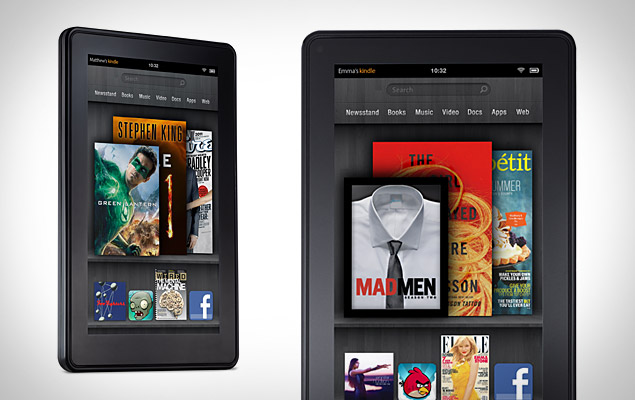
In my next review I'll look at the Kindle as a potential 1 to 1 solution, but today I'd like to look review it as a potential productivity tool for educators.
Review 2: The Kindle as a Productivity Tool for Educators
In my last review, I ended by giving the Kindle a "grade" as a personal media device. What I didn't do, though, was what every educator ought to do when evaluating something, and that is lay out in advance what it is that I'm expecting. We educators like to call those expectations a "rubric." So before I begin this review of the Fire as a productivity tool, I think it only fair to lay out those expectations in advance.
Rubric for Scoring Tablets as a Productivity Tool
For my needs, a tablet for work should have- An email client that will work with a Microsoft Exchange Server
- Some sort of office productivity program, with a word processing program, a spreadsheet program, and a presentation program. It needs to be compatible with Microsoft Office, and needs to allow me to edit the files as well as read them.
- A .pdf reader
- A web browser that is robust enough to allow me to utilize the web applications necessary for my work.
- An app store with the programs I need
A: 5 out of the 5 items above
B: 4 out of the 5 items above
C: 3 out of the 5 items above, and a partial on one of the others
D: 3 out of the 5 items above
F: Fewer than 3 of the 5 items above
Other users might want a microphone and camera so that they can Skype, or a spot for a SIM card so that they can get a monthly data plan and have online access anywhere, but I don't really need those items to be productive. We have wireless access in every building in our district, and on the rare occasion when I'm at work and outside of the district network I can use my cell phone to stay in touch. So the above are my needs.
And out of the box, the Kindle Fire doesn't do so great...
1. Email Client
There is a native email client on the Fire when it comes out of the box, but that client can't connect to Microsoft Exchange environments. There are several apps in the app store, though, that CAN. The problem, though, is that none of them are free. After trying several of them, I've settled on a program called TouchDown. It integrates seamlessly with Exchange. I'm especially impressed by the calendar function of the program, which is so detailed that it even keeps the category colors that I put into my Outlook client. In fact, the TouchDown program looks more like Outlook than the real Outlook program I've seen on Windows phones. Cost of the program: $9.99 in the Amazon app store. OUT OF THE BOX: Fail! WITH SOME WORK: Check!
2. Office Productivity Program
Installed out of the box on the Fire is a program called Quickoffice, a productivity suite that can open Word, Excel, and PowerPoint documents. But the program is View Only--it can't edit the files. In order to be able to edit and create new files, I had to download the program Documents to Go from the Amazon app store. Documents to Go is normally $14.99, but every day Amazon makes one paid app free, and I checked the app store the day that Documents to Go was free, and grabbed the license key at no cost. Not everyone, though, is going to be so lucky. OUT OF THE BOX: Partial check (read only). WITH SOME WORK: Check!
3. PDF Reader
The QuickOffice program can read PDF's, so OUT OF THE BOX: Check!
4. Robust Web Browser
The Silk web browser works fine for me. I can access my work's Help Desk software (It's actually lightning quick for that), as well as several instructional applications I need to access. Our school district's Student Information System has limited success. Parts work and other parts don't. But I think that's a reflection of the SIS more than of the Kindle Fire, and no other Android tablet I've ever seen works flawlessly with it either. For that reason, I'm willing to say that OUT OF THE BOX: Check!
5. An App Store with the Programs I Need
I actually don't mind that Amazon has its own app store separate from the Google Android market. I've been in the Google Android market, and it makes me feel like walking into that bar that Luke Skywalker and Obi Wan Kenobi walked into in the original STAR WARS movie. There are some really questionable apps in there, and I like knowing that the Amazon apps have all been checked before they were allowed to be put in there.
That said, though, I really needed only one application, and that was an app for my school district's walk through program. That app is free in the Android marketplace, but it's not in the Amazon marketplace. And considering the limited interest that would be in such an application, I can't imagine that it ever will be in the Amazon app store. There are also no apps related to any Google products, which seems an intentional snipe on the part of Amazon. So in this case, I'd have to say that the results are OUT OF THE BOX: Fail! WITH SOME WORK: Still Fail!
Overall Grade
OUT OF THE BOX: The Kindle Fire is NOT a good solution for an office productivity tool. Out of the box it only meets my needs in two of the five categories (and SORT OF meets my needs in one other). With that in mind, out of the box the grade has to be...
Grade: F
WITH SOME WORK: After downloading a couple of apps, though, the Kindle Fire serves me a little better. I have my work email, an Office suite, a good web browser, and a PDF reader. The only thing missing is an app store with ALL of the apps I need. But I find that to be a minor annoyance more than a deal killer. I'd be willing to recommend the Kindle Fire as a potential productivity tablet for teachers and administrators, as long as they realize that in addition to the $199 price tag they may need to shell out an additional $25 for the apps they need to get up and running. That would bring the Kindle Fire's total price tag up to $224. That's still only 45% of the price of even the cheapest iPad!
Grade: B
1. Email Client
There is a native email client on the Fire when it comes out of the box, but that client can't connect to Microsoft Exchange environments. There are several apps in the app store, though, that CAN. The problem, though, is that none of them are free. After trying several of them, I've settled on a program called TouchDown. It integrates seamlessly with Exchange. I'm especially impressed by the calendar function of the program, which is so detailed that it even keeps the category colors that I put into my Outlook client. In fact, the TouchDown program looks more like Outlook than the real Outlook program I've seen on Windows phones. Cost of the program: $9.99 in the Amazon app store. OUT OF THE BOX: Fail! WITH SOME WORK: Check!
2. Office Productivity Program
Installed out of the box on the Fire is a program called Quickoffice, a productivity suite that can open Word, Excel, and PowerPoint documents. But the program is View Only--it can't edit the files. In order to be able to edit and create new files, I had to download the program Documents to Go from the Amazon app store. Documents to Go is normally $14.99, but every day Amazon makes one paid app free, and I checked the app store the day that Documents to Go was free, and grabbed the license key at no cost. Not everyone, though, is going to be so lucky. OUT OF THE BOX: Partial check (read only). WITH SOME WORK: Check!
3. PDF Reader
The QuickOffice program can read PDF's, so OUT OF THE BOX: Check!
4. Robust Web Browser
The Silk web browser works fine for me. I can access my work's Help Desk software (It's actually lightning quick for that), as well as several instructional applications I need to access. Our school district's Student Information System has limited success. Parts work and other parts don't. But I think that's a reflection of the SIS more than of the Kindle Fire, and no other Android tablet I've ever seen works flawlessly with it either. For that reason, I'm willing to say that OUT OF THE BOX: Check!
5. An App Store with the Programs I Need
I actually don't mind that Amazon has its own app store separate from the Google Android market. I've been in the Google Android market, and it makes me feel like walking into that bar that Luke Skywalker and Obi Wan Kenobi walked into in the original STAR WARS movie. There are some really questionable apps in there, and I like knowing that the Amazon apps have all been checked before they were allowed to be put in there.
That said, though, I really needed only one application, and that was an app for my school district's walk through program. That app is free in the Android marketplace, but it's not in the Amazon marketplace. And considering the limited interest that would be in such an application, I can't imagine that it ever will be in the Amazon app store. There are also no apps related to any Google products, which seems an intentional snipe on the part of Amazon. So in this case, I'd have to say that the results are OUT OF THE BOX: Fail! WITH SOME WORK: Still Fail!
Overall Grade
OUT OF THE BOX: The Kindle Fire is NOT a good solution for an office productivity tool. Out of the box it only meets my needs in two of the five categories (and SORT OF meets my needs in one other). With that in mind, out of the box the grade has to be...
Grade: F
WITH SOME WORK: After downloading a couple of apps, though, the Kindle Fire serves me a little better. I have my work email, an Office suite, a good web browser, and a PDF reader. The only thing missing is an app store with ALL of the apps I need. But I find that to be a minor annoyance more than a deal killer. I'd be willing to recommend the Kindle Fire as a potential productivity tablet for teachers and administrators, as long as they realize that in addition to the $199 price tag they may need to shell out an additional $25 for the apps they need to get up and running. That would bring the Kindle Fire's total price tag up to $224. That's still only 45% of the price of even the cheapest iPad!
Grade: B
Thursday, November 24, 2011
Kindle Fire Review...Part One

Except...
I want to put a little bit of a slant on my review. After all, the reason I was very excited about the Kindle Fire when I first learned about it was not because I particularly wanted one for myself (though I did). I was much more intrigued by what a sub-$200 tablet could mean for education. After all, for years I've heard experts say that 1:1 computing initiatives (where every student in a school has a computing device that they carry around with them) becomes a real possibility once the cost for the device gets below $200. Have we finally arrived?
So I'm going to give three very brief reviews of the device. First, I'll review it as a personal media consumption device (which is how Amazon intends it to be used). Second, I'll review it as a possible administrative tool in an educational setting (Could it be a low cost replacement to an iPad for administrators?). Finally, I'll review it as a possible 1:1 instructional device.
Review 1: The Kindle as a Media Consumption Device
Let's get this straight: It's not Amazon that has been referring to the Kindle Fire as a potential iPad killer, or at the very least as the first serious threat to the iPad in the tablet market. That's been all the doing of journalists. Amazon has been saying since the beginning that the Kindle Fire was about media consumption, about driving people to Amazon's content.
And at that, the device gets high marks. As an almost-tablet for watching movies, listening to music, or reading books, the device is great. It's easy to set up, it's mostly bug free, and since I purchased mine from the Amazon website, it came to my house preconfigured with my settings in it, so it was ready to go almost as soon as I got it out of the box (I did have to put in my Wi-fi settings, but that's true for any wireless device). If I'd purchased the device at Best Buy or some other place other than Amazon, I would have had to link it to my Amazon account, but that takes no more effort than typing in the email address associated with your Amazon account and your Amazon password (I know because I deregistered the device as soon as I connected to the Wi-Fi so that I could see what registration was like).
Once setup was complete, all of my previous Amazon digital content (about 80 MP3's, all five seasons of DEXTER, and a couple of books) was available on my Fire to browse in Cloud mode or download for offline consuming. It was a breeze. And since I'd already signed in with an Amazon account, there was no need to register for the Amazon app store. I was ready to go.
I'm very happy with my Kindle as a personal device. Some people have complained that it's too small, as it's only about half the size of an iPad, but I actually LOVE its small size. Any smaller and I'd have trouble reading the text, and any larger (as in the size of an iPad) and I think I'd find it cumbersome to carry around. This Fire is right about the size of a cheap paperback book. It would easily fit in a purse (not that I have one). Heck, it would probably fit in some of my pockets. Others might prefer a bigger screen, but I am very happy with this.
Other people have complained that the screen responsiveness isn't as exact as an iPad. I wouldnt' know. I haven't spent a lot of time with an iPad. I can say it's on par with the screen of pretty much every other Android device I've ever played with. It works fine for me. Others have said that the Kindle Reader app, the thing that Fire ought to excel in, is a little buggy. I'd say I have seen that. There have been a couple of times when I've had to touch the side of the page more than once or twice to get the page to "turn," but it hasn't been a huge deal to me.
Others have complained that the Silk browser is buggy and slow. A couple of blog posts ago I wrote about how, indeed, the browser is slower when Amazon's "Accelerator" caching is turned on. I've since turned my caching off, and I'd say the browser is fast enough for me. I'm not bothered by the little bit of a wait, and I haven't found a web page yet that didn't display correctly.
I will say this, though: I am more bothered than I thought I would be by the lack of a microphone and a camera. When I first read that they weren't included, I thought, "No big deal. I don't plan to Skype with this thing, and I have plenty of other devices that can take digital pictures." But I wasn't thinking big enough. I went into the Amazon app store a couple of days ago looking for a bar code reading program, and there wasn't a one to be found. I had to think about that for a moment before realizing that without a camera the app would be useless. I did the same thing the next day looking to see if Shazaam was in the app store. Shazaam is pretty useless without a microphone, so what's the point? I'm assuming that I'll continue to find apps that aren't going to do what I want because there's no microphone or camera. Or GPS for that matter (The Fire is the perfect size to function as a GPS navigator).
I understand why Amazon left those items out, and they were right to do so. Adding all of them would probably have increased the price of the Fire by a good $100 or $150, and that would have impacted my decision to purchase it. At $199, I purchased the Fire immediately, almost as an impulse purchase. If it had been priced at $349, though, I would have been much less impulsive about the purchase, and I would have started to question why I shouldn't just go ahead and fork over another $150 and get a low end iPad. So Amazon had to drop some things to get to that affordable price point, but I'm finding the missing items are bothering more than I expected.
All that said, I don't regret the purchase. I love the Fire, and I love even more what it and devices like it could mean for the field of education. I'll write about that, though, in a later blog post. For now, I'll close out this post with an overall verdict on the Fire as a personal device. And as I'm an educator, I'll use a report card analogy...
Grade: B
Teacher's Comments: Love the price, the ease of setup, and the size. Hate that there's no camera, microphone, or GPS, but considering the price and what you DO get, this device is worth considering, especially if all you're planning to do with a tablet is browse the Internet, check Facebook, and watch a movie.
Wednesday, November 23, 2011
Thanksgiving Eve
Today is the day before Thanksgiving. A year ago today--the Wednesday the day before Thanksgiving--was a regular work day for me. While the students and teachers in my school district don't work the day before Thanksgiving, it IS a work day for the office staff, and I got up as I do every work day at 5 AM to exercise. If the weather is nice enough (not raining and above 40 degrees) I go running. If it's not, I use the elliptical and the universal weight machine in the basement. Last Thanksgiving Eve morning I had just gotten on the elliptical when I heard the phone in the basement ring. I leaped off the elliptical machine and sprinted to the phone. I was the only one awake in the house; everyone else had started their Thanksgiving Break, and I didn't want them to wake up.
I grabbed the cordless phone off its dock and looked at the name on the caller ID. I expected it to be the board of education phone number, or some cell number of someone from work, someone calling to let me know that the Internet was down or the electricity was out or something of that sort. The phone number wasn't local, though, and the name on the Caller ID said "Black, Ann." My sister. My head was spinning as I answered the phone. My sister never called me pretty much ever, much less at 10 minutes after five in the morning. I knew something was wrong.
She told me, in a pretty matter of fact, unconcerned voice, that our dad had been taken to the hospital overnight with a burning in his chest and pains. She also said, though, that he had just changed his blood pressure medicine two days before, and that he'd been feeling bad ever since.
"Oh," I said, feeling relieved. "That's probably all it is, then. He's having a reaction to his new medicine. They'll keep him for a day or two just to check him and he'll be fine." She told me she'd keep me informed, and then we hung up. My wife, who HAD been awakened by the phone ringing, had also seen the name on the caller ID and had also had the same feeling of dread I had. She'd picked up the extension in the bedroom and heard the conversation I'd had with my sister, and she came downstairs and asked me if I was going to stay home from work and drive down to Frankfort to see my father. I told her no, it didn't sound like it was really all that serious. I was going to finish my workout and go into work, and that's just what I did.
I'd been at work for just a couple of hours, though, when my other sister called to tell me that my father had had a heart attack, a pretty serious one, and he was being transferred to a hospital in Lexington. I bolted out of work quickly, telling the receptionist at the front desk as I whizzed past her, "My father's had a heart attack. I won't be back in today. Wish everyone a Happy Thanksgiving and I'll keep you guys informed." And I took off for Frankfort.
The rest of the day is really fuzzy for me. I was thinking about writing this post earlier, and it occurred to me that I don't remember whether--that first time I drove down to Lexington--my wife was with me or not. It seems to me that maybe she was, but I can't imagine what we would have done with the kids, and I also can't imagine that--with our house being in the opposite direction from my work as the hospital in Lexington--that I would have been composed enough to turn north on the Interstate and go home rather than turning south and immediately heading for the hospital. I do remember being in the hospital with most of my family, and I remember my older sister and me going into a consult room to talk to the surgeon who said that, as soon as my father stabilized, he'd operate. He said it would most likely be Tuesday, but then my father's doctor came in and said he wanted the operation to happen sooner, Sunday if possible. Both days seemed so far away to me, but when I saw my father that day he looked pretty good, and I know that I went home that night and came back down the next day with my entire family.
I don't mean to give you a point by point of the day. All I'm trying to say is this: My father died the Monday after Thanksgiving, and from Wednesday until then is all kind of a mush of memories in my brain. And I'll be thinking about my father a lot today. When my alarm goes off in just a few minutes at 5 AM, and when I get on the elliptical and start my morning workout, that phone call from my sister last Thanksgiving Eve will be large in my mind.
I grabbed the cordless phone off its dock and looked at the name on the caller ID. I expected it to be the board of education phone number, or some cell number of someone from work, someone calling to let me know that the Internet was down or the electricity was out or something of that sort. The phone number wasn't local, though, and the name on the Caller ID said "Black, Ann." My sister. My head was spinning as I answered the phone. My sister never called me pretty much ever, much less at 10 minutes after five in the morning. I knew something was wrong.
She told me, in a pretty matter of fact, unconcerned voice, that our dad had been taken to the hospital overnight with a burning in his chest and pains. She also said, though, that he had just changed his blood pressure medicine two days before, and that he'd been feeling bad ever since.
"Oh," I said, feeling relieved. "That's probably all it is, then. He's having a reaction to his new medicine. They'll keep him for a day or two just to check him and he'll be fine." She told me she'd keep me informed, and then we hung up. My wife, who HAD been awakened by the phone ringing, had also seen the name on the caller ID and had also had the same feeling of dread I had. She'd picked up the extension in the bedroom and heard the conversation I'd had with my sister, and she came downstairs and asked me if I was going to stay home from work and drive down to Frankfort to see my father. I told her no, it didn't sound like it was really all that serious. I was going to finish my workout and go into work, and that's just what I did.
I'd been at work for just a couple of hours, though, when my other sister called to tell me that my father had had a heart attack, a pretty serious one, and he was being transferred to a hospital in Lexington. I bolted out of work quickly, telling the receptionist at the front desk as I whizzed past her, "My father's had a heart attack. I won't be back in today. Wish everyone a Happy Thanksgiving and I'll keep you guys informed." And I took off for Frankfort.
The rest of the day is really fuzzy for me. I was thinking about writing this post earlier, and it occurred to me that I don't remember whether--that first time I drove down to Lexington--my wife was with me or not. It seems to me that maybe she was, but I can't imagine what we would have done with the kids, and I also can't imagine that--with our house being in the opposite direction from my work as the hospital in Lexington--that I would have been composed enough to turn north on the Interstate and go home rather than turning south and immediately heading for the hospital. I do remember being in the hospital with most of my family, and I remember my older sister and me going into a consult room to talk to the surgeon who said that, as soon as my father stabilized, he'd operate. He said it would most likely be Tuesday, but then my father's doctor came in and said he wanted the operation to happen sooner, Sunday if possible. Both days seemed so far away to me, but when I saw my father that day he looked pretty good, and I know that I went home that night and came back down the next day with my entire family.
I don't mean to give you a point by point of the day. All I'm trying to say is this: My father died the Monday after Thanksgiving, and from Wednesday until then is all kind of a mush of memories in my brain. And I'll be thinking about my father a lot today. When my alarm goes off in just a few minutes at 5 AM, and when I get on the elliptical and start my morning workout, that phone call from my sister last Thanksgiving Eve will be large in my mind.
Tuesday, November 22, 2011
The Kindle Fire's Silk Browser
When the Kindle Fire was announced several weeks ago (and by the way, I bought my Fire less than an hour after it went on sale that day), one of the items promoted heavily was the web browser built into the Fire. It was called "Silk," and it was going to revolutionize the Internet web browser experience by taking the processing power out of the hands of the local machine and putting it in the hands to Amazon's massive cloud of servers. It was SUPPOSED to speed up web browsing on the Kindle Fire significantly.
But then, once the Fire was released last week, reports started coming in that the Silk browser was pretty slow, and that it actually was SLOWER when the Acceleration was running. I didn't believe it, and so I set out to see for myself. And what I found was...all of those websites were right. The browser is slower when the Accelerator is running!
To test this theory, I loaded two websites (THIS website and http://cincinnati.com, a site which--in my experience--takes a VERY long time to load) with 1) my home computer (2.4 Ghz Core 2 Duo Windows 7 machine with 3 GB of RAM) and with the Fire both 2) with the accelerator turned on and 3) off. I loaded each site five different times for each, clearing the history and cache of all three after each site visit. I then used a stop watch to see how long it took each site to fully load. Here's what I found:
Site: Sweasy.net
Attempt | Computer | Fire w/ Acceleration | Fire w/o Acceleration |
1 | 5.9 | 9.2 | 7.3 |
2 | 3.6 | 14.4 | 8.0 |
3 | 3.7 | 7.4 | 6.3 |
4 | 3.7 | 11.7 | 7.4 |
5 | 3.7 | 7.4 | 8.2 |
Average | 4.12 | 10.02 | 7.44 |
Site: Cincinnati.com
Attempt | Computer | Fire w/ Acceleration | Fire w/o Acceleration |
1 | 4.5 | 11.9 | 12.4 |
2 | 4.9 | 12.8 | 12.1 |
3 | 4.4 | 11.6 | 11.4 |
4 | 4.1 | 12.3 | 10.9 |
5 | 3.7 | 11.1 | 10.7 |
4.32 | 11.94 | 11.5 |
I would describe this website as taking a moderate amount of time to load (It has a Twitter feed and an eschool news feed which slow it down, as well on this day as a YouTube video on the home page which took a few second to load). After five tries, my computer loaded the page in an average of 4.12 seconds. The Kindle Fire without acceleration turned on loaded the page in 7.44 seconds, taking almost twice as long. When the accelerator was turned on, though, the Kindle Fire took more than 10 seconds to load! That's much more than twice as long as it took my computer to load, and it's 25% longer than it took the Fire to load in its "slower" mode with the accelerator turned off.
When I ran the same test at Cincinnati.com the results were a little less dramatic. There's a LOT of loading of secondary content on that site (ads and video and external news feeds), and while loading the page on my computer only took a few tenths of a second longer than this web site did, both the Silk accelerated and Silk non-accelerated tests took more than 11 seconds. The accelerated browsing still took a little longer, but this time was only .44 seconds slower than the Fire was when it had acceleration turned off.
But I guess that's missing the point. The browser is supposed to be FASTER when the accelerator is turned on, not "just a little bit slower." So regardless of whether or not the Amazon Kindle Fire is a success, I'd have to call their Silk web browser a failure. A big one.
When I ran the same test at Cincinnati.com the results were a little less dramatic. There's a LOT of loading of secondary content on that site (ads and video and external news feeds), and while loading the page on my computer only took a few tenths of a second longer than this web site did, both the Silk accelerated and Silk non-accelerated tests took more than 11 seconds. The accelerated browsing still took a little longer, but this time was only .44 seconds slower than the Fire was when it had acceleration turned off.
But I guess that's missing the point. The browser is supposed to be FASTER when the accelerator is turned on, not "just a little bit slower." So regardless of whether or not the Amazon Kindle Fire is a success, I'd have to call their Silk web browser a failure. A big one.
Subscribe to:
Posts (Atom)